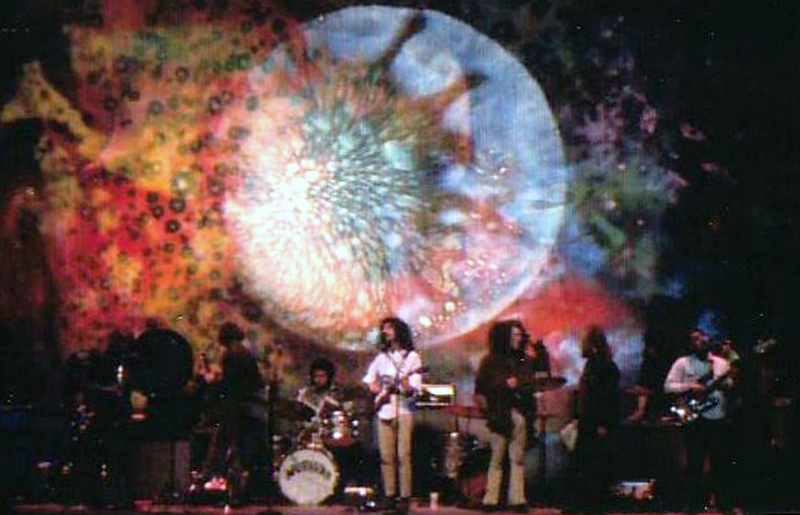
Psychedelic light shows
Light shows were part of a key fusion between image and sound, much like a psychedelic experience, and aimed to emulate the feeling of total saturation, creating imagery improvised around the music being played in whatever setting the show was being hosted. In the case of psychedelic rock, it was an example of a wholly engaging environment to accompany a psychedelic trip. The light show has its origins in the beat era, which were initially ordinary slides projected onto the walls of the venue when a poet or writer was performing. The methods used in light shoes started to improve with the birth of modern jazz. Needing an accompaniment, different techniques were tried out, with “hot coloured oils and inks were swirled in glass bowls under the glare of several overhead projectors” which were beamed out over the audience, the patterns made as spontaneous as the flow of the jazz. Regarded as the pioneer of the light show, Bill Ham created The Light Sound Dimension, using electric flow to stimulate kinetic material on a 6 x 4 board, as well as using over head projectors as the canvas for further paintings. As psychedelic rock took off, more light show companies formed, to point where there reportedly nearly one hundred in the San Francisco area. Two of the biggest names were Brotherhood of Light, and Headlights, who only worked with Jefferson Airplane. Branching out from oils and coloured lights, the variety of formats increased drastically, to include items such as “showing strange slides or super 8mm film loops of train crashes and autopsy footage that were speeded up or projected backwards to create a surreal effect.”
Further techniques were used to mirror even further the effects of LSD, where “the liquid lights would then be projected over so that the flickering image could only be partly seen, to give the illusion of an acid trip that had reached its peak” Over in Manhattan, New York, Bill Graham opened the Fillmore East, complete with Joshua White’s Joshua Light Show, which was regarded as one of the leading and innovative light shows of the sixties. Edwin Pouncey described the scenes as the light show was at work; “Glycerine, alcohol, oil and water spat, boiled and separated into amoebic patters during one of these so called “wet shows”, in which the skilled operators would, as in free jazz, visually improvise around the music, with White as the principle conductor.” White had an experienced background in fashion and stage lighting at theatres, so the shows always ran professionally, and with the trust gained from this, White and his assistants had the room to experiment with different ideas and techniques. The light show had a purpose built platform at the back of the auditorium, with the venue having a very understanding relationship with the group. Using various aniline dyes mixed with water, the unique way of layering different mediums gave Graham the edge over his competitors. Commenting on this technique, Graham said “we never just showed a film, it was always just a section of film mixed with a slide and something else. The results were arrhythmic and therefore it was the audience and musicians which gave it a rhythm.”
With the dawn of back projections came the ability to photograph the light show with a flash without losing the background. Iron Butterfly’s In-A-Gadda-Da-Vida and Country Joe and the Fish’s Electric Music For The Mind And Body both used images with light show projections on their covers.
Light shows were not restricted to the US, with the UK’s evolution of light shows coming about in the same fashion, emerging from the coffee shops before spilling into music venues, the first one of note being the UFO club in London, opening on 23rd December, 1966, with Pink Floyd playing, and the lighting by Peter Wynne-Wilson. The Sensual Laboratory took over shortly after, ran by Mark Boyle, a notorious artist, who had previously used projection techniques in works such as Suddenly Last Supper (1964) and Son et Lumiere for Insects, Reptiles & Water Creatures (1966). Although not made for a psychedelic experience, it would be wrong not to mention Andy Warhol’s Exploding Plastic Inevitable, due to the sheer ambition and scale of the piece, and the fact that it was a complete multimedia experience, in line with the reason that the lightshows in London and San Francisco had sprung up in the first place. The show was put together and toured from 1966 to 1967, containing a barrage of effects. Brandon W Joseph pieces the scene together impeccably in his description of the piece: “at the height of its development, the exploding plastic inevitable included three to five film projectors, often showing different reels of the same film simultaneously, a similar number of slide projectors, movable by hand so that their images swept the auditorium, four variable speed strobe light, three moving spots with an assortment of gels, several pistol lights, a mirror ball hung from the ceiling and another on the floor, as many as three loudspeakers blaring different pop records at once, one or two sets by the velvet underground and nico, and the dancing of Gerard Malanga and Mary Woronor or Ingrid Superstar, complete with props and lights that projected their shadows high onto the wall”. It is easy to gather from this description alone just how alarming stepping into this circus would have been; a sensory barrage of sound, light and colour, jarring reactions with the abundance of material to react to. The project had developed from Warhol’s earlier forays into film, the first incarnation created for the second annual New York Film festival, in the lobby of the Lincoln centre’s philharmonic hall, which has looped three minute segments of his films Eat, sleep, kiss, haircut projected individually but simultaneously onto the wall from Fairchild 400s. Another key influence into the final outcome was Barbera Rubin’s “uptight” collaboration, which involved her aggressively questioning audience members at Warhol’s film premieres. This level of confrontation was aimed for in the EPI, invading the viewer as a participant in the chaos. As technology evolved, the appeal of light shows diminished. The music changed and the musicians wished to be seen and remembered, rather than being hidden in the patterns, and modern lighting gained popularity.
Projections and immersion
The creation of an immersive environment through the use of projections has been prevalent in what is termed as “expanded cinema” since the invention of the stereopticon in 1894. This device aligned sixteen slide projectors in a semi circular room, curtained on the opposite side, changing the images in rapid succession. While this did not create a faultless image, it did pave the way for film projectors to break out of the traditional setting of a single image on a flat wall.
Using similar techniques, in 1900 the Cineorama; ten film projectors linked to create a 360 degree image was featured at the world exhibition in Paris. This marked the beginning of immersive environments at World trade fairs, which continued from this point to use prototypes in technology to create or show artificial worlds, be it through wall long, hallway length projections, such as Futurama in 1939, or Teleview, in 1921, which introduced 3D films to the American public.
While the 360 degree environment was not built on in a mainstream environment, coverage of 180 degrees was brought to the American public by Fred Waller. His Cinerama cinemas utilised three projectors in a semi circle, with filming undertaken by three cameras, with a slight overlap in their field of view. The audience however, were not in the curved section of the screen, meaning the curvature was unnecessary, as a flat screen would serve the same goal. None the less, the cinemas hosting the specially designed equipment proved popular, at their peak in the early sixties numbering over one hundred worldwide.
The next step towards immersion was the Sensorama Simulator. The device communicated not only visually, but hapticly, vibrating and letting off chemicals whose smells corresponded with the images in front of the viewer. The machines hosting the equipment were normally confined to theme parks however, as the experience was only relayed directly to the viewer, and not applicable for a wider audience seeking a social experience as well as an immersive one. Some traditional cinematic experiences attempted to bring some of these elements into their shows; Earthquake (1974) and The Tingler 1959) included specially designed vibrating seats, and Polyester (1981) gave out cards which gave of smell when scratched, to be used at certain points of the film.
Looking to immersion, the Omnimax cinema projected onto a huge overhead sphere, so the coverage was 160 degrees of the viewer’s vision. The company behind the Omnimax, IMAX, run cinemas with huge screens, where the audience must wear 3D glasses, creating immersive illusions in front of them.
Using similar techniques, in 1900 the Cineorama; ten film projectors linked to create a 360 degree image was featured at the world exhibition in Paris. This marked the beginning of immersive environments at World trade fairs, which continued from this point to use prototypes in technology to create or show artificial worlds, be it through wall long, hallway length projections, such as Futurama in 1939, or Teleview, in 1921, which introduced 3D films to the American public.
While the 360 degree environment was not built on in a mainstream environment, coverage of 180 degrees was brought to the American public by Fred Waller. His Cinerama cinemas utilised three projectors in a semi circle, with filming undertaken by three cameras, with a slight overlap in their field of view. The audience however, were not in the curved section of the screen, meaning the curvature was unnecessary, as a flat screen would serve the same goal. None the less, the cinemas hosting the specially designed equipment proved popular, at their peak in the early sixties numbering over one hundred worldwide.
The next step towards immersion was the Sensorama Simulator. The device communicated not only visually, but hapticly, vibrating and letting off chemicals whose smells corresponded with the images in front of the viewer. The machines hosting the equipment were normally confined to theme parks however, as the experience was only relayed directly to the viewer, and not applicable for a wider audience seeking a social experience as well as an immersive one. Some traditional cinematic experiences attempted to bring some of these elements into their shows; Earthquake (1974) and The Tingler 1959) included specially designed vibrating seats, and Polyester (1981) gave out cards which gave of smell when scratched, to be used at certain points of the film.
Looking to immersion, the Omnimax cinema projected onto a huge overhead sphere, so the coverage was 160 degrees of the viewer’s vision. The company behind the Omnimax, IMAX, run cinemas with huge screens, where the audience must wear 3D glasses, creating immersive illusions in front of them.
Testing abstract projections.
Testing animations, distorted in after effects to create completely abstract patterns. The input is block colour in a grid. These are effectively just pretty patterns if the methodology is not relevant.
Personal Account: Dover
Wanting to experience something of the sublime in England, I ventured to Dover’s famed white cliffs, in search of awe, wonder and dread. While the romantic writers were inspired by mountainous peaks and deep chasms, observed whilst trekking through mountainous alpine territories, these are not in abundance in South England. The iconic rock face proved just as fulfilling however, as the historic symbol of England provided its own spectacular response. While the bridleways are well worn and populated by tourists, dog walkers and local residents, rather than the craggy, narrow footpaths from the Romantic paintings, walking just off the beaten track, into the long grass near the edges of the rocks, allows a sample of magnitude and awe, in equal measure to the corresponding apprehension and vertigo. Moving carefully towards the steep decline, on one weathered outcrop, I looked to the east, gazing along the miles of ancient rock, white from the chalky earth, with brash streaks of black from flint, almost abstract in appearance, with the long, deep brows beaten out of the stone by years of stiff breezes, rain, and the ocean. Moving carefully towards the steep decline, on one weathered outcrop, I looked to the east, gazing along the miles of ancient rock, white from the chalky earth, with brash streaks of black from flint, almost abstract in appearance, with the long, deep brows beaten out of the stone by years of stiff breezes, rain, and the ocean. The sheer beauty of the scenery ultimately holds you; on reaching what seemed to be the summit, rich, green fields become visible, stretching out towards a forest in the difference, with frail fog whisking across, the sunlight casting kaleidoscopic patterns as it moves behind clouds. The rolling countryside is then sharply cut into by the ominous deep streak of white, which leads down to the pulsating deep blue. It is breathtaking. Later, further to the West at Abbots Cliff, the weather has become much worth, the wind is far stronger and constant, bring dense fog with it, dimming what is left of the afternoon light, which quickly descends into near darkness. The lights from Folkestone, a mile away, barely punctuate the thick haze, with visibility minimal. The cliff edge is only apparent when a metre or so away, the only indication of the drop being the glint of light bouncing off distant waves. While the elements are in full force, it is possible to admire the reckless authority nature holds over the area, it feels like you are only permitted to witness this scene because the forces are allowing it, with a change in wind direction capable of sending you tumbling from your vulnerable position. This experience proves more threatening, however leaves wonder at how much control nature has over you, leaving you totally aware of your limitations, vulnerability, and your complete lack of importance in the face of true epicness.
Projection mapping
Projection mapping is the use of projectors to manipulate a piece of internal or external architecture. This is achieved by covering the surface with light from the projector. If it is a particularly large, or three dimensional layouts, more than one projector can be used, and then linked through a single computer. Once the surface is satisfactorily covered, there is usually what is effectively an overspill, where light may be falling on the pavement in front of the selected surface, or onto the ceiling. These areas are then removed by applying a layer of black pixels on the screen in the correct place, so light there is no longer bright enough to register. The light in place works in the same way as a light bulb, so the surface appears lit by a spotlight if entirely black. With the work area in place, the surface needs to be laid out by using UV mapping, similar to 3D program such as Maya. This works by applying and moving a grid on the projection to be evenly placed, moving the lines to be an equal distance apart. Any separate walls can be laid out and added to a master copy. With the surface in place, animations can be placed onto the grid to correspond with the architecture of the building, for instance a window can be outlined with a V glow, or certain parts of the façade can be coloured. The surface becomes a breathing canvas, which can be edited however the artist wishes. Advertising companies are frequent users of the technique, manipulating flagship shops or newly opening buildings, however some have branched out, recently cars have become a popular surface. Acting as a lightshow, passersby and people who are aware of the event can revel in the attraction of seeing concrete architecture move, spin, fall apart, change colour and pulsate. Specialist software is available on commercial licences, and is popular amongst VJs in live arenas as well as architectural mappers. The technique of laying out UVs will be needed in some form should I press ahead with an environment.
Using Projections
The sublime as an experience transcends all possible forms of depiction; however this unattainable goal has always been noted; Romantic painters depicted the motion of water, and used impressionistic strokes to capture the essence of the images in front of them, with realism coming second to imagination. The abstract expressionists took the approach towards the capturing of the sublime differently, making the painting itself the experience, with representation becoming completely abstract, the transcendent moment coming from the energy and power of the paintings themselves. Both however, as paintings, have no physical motion, although due to the quality of work feel as if they do, allowing the viewers imagination to construct narrative around the painting, rather than have the artist choreograph the experience.
The use of animation can control the experience more directly, which leads to the issue of whether or not this helps the work towards evoking the sublime. As a personal experience, assigning personal meaning would be more likely to achieve success, although it requires the viewer to dedicate themselves to the artwork. Animation can show movement and help the person make the speculative leap, involving them in the work. However this comes at the price of controlling the movement in front of the person, making the sublime depiction in front of them believable, rather than at the edges of the imagination. Through projections, the viewer can become more involved with the work, bonding them as a spectacle themselves, rather than as a passive observer. It allows the next step towards immersion from abstract expressionist painting, as they themselves stepped into the scenes the romantics depicted. Installations such as the work of James Turrell have already achieved this, using light as their material, and projections work in the same way; the projection itself is just light filtered in a more complex fashion.
It is the presentation of digital form in a physical format however that can provide the catalyst for the sublime, as a world which doesn’t exist can become evident and tangible for the viewer, who would ordinarily see images from a digital environment on a monitor in front of them. This contradictory element, of the invisible and intangible becoming the exact opposite, can wow the viewer by testing their understanding of technological structures. By projecting onto an entire environment rather than just on wall, the work becomes confrontational, leaping from the now usual cinematic layout of a large screen on a single wall, reaching towards the audience, manipulating and moving the floor, so the most concrete and dependable of elements, the ground on which a person stands, is claimed back by the work, removing the reliability of ordinary perception. When moving in its entirety, the whole environment can seem to crawl, bend and breathe, provoking awe by bringing inanimate objects to life. For this reason, the ideal vehicle to carry a digital piece of art aiming to evoke the sublime, is a projection based installation.
Psychedelia and the Sublime
While often overlooked as a bi-product of the counterculture movement and an also-ran alongside the dominant Pop Art movement in the 1960s, psychedelia possesses enough of its own individual merit to stand as a continuation of Romantic thought, particularly regarding the evoking of the sublime.
The movement shares an intimate link with the popularisation of the psychedelic drug LSD, as the work created is directly inspired by the effects it produces. Psychedelic directly translated means “mind-manifesting” in Greek, and was coined by Humphrey Osmand in 1956 to author Aldous Huxley, writing ‘I have tried to find an appropriate name for the agents under discussion: a name that will include the concepts of enriching the mind and enlarging the vision…My choice, because it is clear, euphonious and uncontaminated by other associations, is psychedelic, mind-manifesting.’ The drug itself was created in 1938 by Swiss chemist Albert Hoffman, giving it a very recent start date in comparison to drugs such as Psilocybin and Dimethyltryptamine, which had been in use for thousands of years. Arguably any work created under these substances the creation of LSD could retrospectively be called psychedelic, as the drugs are now grouped under the same umbrella in terms of drug classification, however the art movement itself was triggered specifically by the spread of LSD and an increased level of consumption and creative output, co-inciding with the growth of what is now called the sixties counterculture, a loose group of protestors and objectors to mainstream life and politics, liberal in leaning and more willing to experiment with substances.
The effect of the drug is important, as to understand it is to see why the artwork inspired and created for the experience tries to evoke the sublime.
On first trying the substance, creator Hoffman reported ‘a not unpleasant intoxicated-like condition, characterized by an extremely stimulated imagination. In a dreamlike state, with eyes closed…I perceived an uninterrupted stream of fantastic pictures, extraordinary shapes with intense, kaleidoscopic play of colours.’ (Hoffman, 1980)
Initially the drug was used in medical facilities, as it was thought to mimic the effects of schizophrenia, and also to treat other drug dependencies, such as heroin and alcohol, with 33 and 50 percent success rates reported respectively. Experiments also found a large creative boost when experiments were conducted on artists.
Researchers, scientists and other academics who had access to such supplies began to take the drug recreationally in private, but it was not long until through a mixture of enthusiasts such as Timothy Leary and medical trial subjects such as Ken Kasey, that word of LSD and the experience under the drug reached a wider sphere of people. Leary wrote books a conducted lectures, viewing the effects in an almost religious light, where as Kasey went on tour, promoting the drug at “Acid Tests”. Once dosages were being created by backstreet chemists, it was not long before the governments of all countries where LSD was popular banned it, in 1966, creating scare mongering adverts and imposing custodial sentences on those caught dealing and partaking. Eventually the movement petered out with the counter cultural movement, as protest movements stopped and more widespread crackdowns on the drug meant that less people were falling under the spell of LSD.
The artwork itself had hallmarks of the visions that the drug generated. Chris Grunenberg (2005a,7) writes psychedelia as ‘the result of a highly productive interaction between art, technology, politics, drug culture, music and many other influences, creating an extraordinary aesthetic exemplifying the spirit of liberation and freedom”, with Fred Tomaselli listing the aesthetic qualities:
‘…Psychedelia was the beginning of pop culture’s post-modern style war. It was a carnival of repressed histories and multicultural theft, hybridising German Romanticism, William Blake, Surrealism, Pop, sci-fi illustration, comics, jazz age cartoons, Asian, animist and Islamic art, druidism, hot rod and surf culture, art nouveau, leftist agitprop and, of course, cowboys and Indians’ (Tomaselli, 2005, 206).
The use of illegible text, clashing colours, deformed shapes, appropriated icons, surrealist elements and classical figures were all common and related to the feeling of being “under the influence”.
Psychedelic rock and pop aimed to enhance and capture the editing of sound as it is heard having taken the drug Simon Reynolds (2005, 147) describes psychedelic music below;
‘…hallmark psychedelic effects typically involve the smearing of sounds and chromatic intensification. Effects such as phasing, flanging, and ‘swirling’ blur the edges of specific instruments and create a miasmic effect, a cloud of sound seeming to swarm out of the speakers and enfold the listener.’
Light shows (see separate blog entry) accompanied the live playing of music, enhancing the experience to be multi-sensory and more stimulating, creating an environment rather than just a visual focus.
What has not been discussed is what makes this experience sublime.
LSD works by blocking sensory neurons which transmit data to the brain. This was explained in detail by Dr Karl Jansen in the BBC Horizon programme Psychedelic Science. ““Psychedelics can block the transmission of messages from the outside world to the inside and it does that by selectively blocking the action of chemical messages which carry the message from neuron to neuron. If you block that perception or sensation from coming in, there will be a bit of a vacuum in your mind, and nature tends to abhor a vacuum so you mind fills it up with memories, perceptions and meaning, if you like, so there are lot of changes going on in a neuro-electrical sense, and you give it meaning; your mind gives it meaning. As a result of that you can see the world in a new way.”
The effect that this produces is sublime as it is not of a rational world. The brain’s subconscious images are so removed beyond the realms of reality that, to paraphrase William Blake, the doors of perception are cleansed, moving the taker to a sublime state, where the imagination and subconscious make up the perception of the world around them. As there is no possible comprehension for such a state, as nothing is based on reality, the mixture of awe and wonder can be linked to the experiences of the natural sublime, where mountains and chasms held the same ambiguous structure, unfathomable yet visible to the eye.
The movement shares an intimate link with the popularisation of the psychedelic drug LSD, as the work created is directly inspired by the effects it produces. Psychedelic directly translated means “mind-manifesting” in Greek, and was coined by Humphrey Osmand in 1956 to author Aldous Huxley, writing ‘I have tried to find an appropriate name for the agents under discussion: a name that will include the concepts of enriching the mind and enlarging the vision…My choice, because it is clear, euphonious and uncontaminated by other associations, is psychedelic, mind-manifesting.’ The drug itself was created in 1938 by Swiss chemist Albert Hoffman, giving it a very recent start date in comparison to drugs such as Psilocybin and Dimethyltryptamine, which had been in use for thousands of years. Arguably any work created under these substances the creation of LSD could retrospectively be called psychedelic, as the drugs are now grouped under the same umbrella in terms of drug classification, however the art movement itself was triggered specifically by the spread of LSD and an increased level of consumption and creative output, co-inciding with the growth of what is now called the sixties counterculture, a loose group of protestors and objectors to mainstream life and politics, liberal in leaning and more willing to experiment with substances.
The effect of the drug is important, as to understand it is to see why the artwork inspired and created for the experience tries to evoke the sublime.
On first trying the substance, creator Hoffman reported ‘a not unpleasant intoxicated-like condition, characterized by an extremely stimulated imagination. In a dreamlike state, with eyes closed…I perceived an uninterrupted stream of fantastic pictures, extraordinary shapes with intense, kaleidoscopic play of colours.’ (Hoffman, 1980)
Initially the drug was used in medical facilities, as it was thought to mimic the effects of schizophrenia, and also to treat other drug dependencies, such as heroin and alcohol, with 33 and 50 percent success rates reported respectively. Experiments also found a large creative boost when experiments were conducted on artists.
Researchers, scientists and other academics who had access to such supplies began to take the drug recreationally in private, but it was not long until through a mixture of enthusiasts such as Timothy Leary and medical trial subjects such as Ken Kasey, that word of LSD and the experience under the drug reached a wider sphere of people. Leary wrote books a conducted lectures, viewing the effects in an almost religious light, where as Kasey went on tour, promoting the drug at “Acid Tests”. Once dosages were being created by backstreet chemists, it was not long before the governments of all countries where LSD was popular banned it, in 1966, creating scare mongering adverts and imposing custodial sentences on those caught dealing and partaking. Eventually the movement petered out with the counter cultural movement, as protest movements stopped and more widespread crackdowns on the drug meant that less people were falling under the spell of LSD.
The artwork itself had hallmarks of the visions that the drug generated. Chris Grunenberg (2005a,7) writes psychedelia as ‘the result of a highly productive interaction between art, technology, politics, drug culture, music and many other influences, creating an extraordinary aesthetic exemplifying the spirit of liberation and freedom”, with Fred Tomaselli listing the aesthetic qualities:
‘…Psychedelia was the beginning of pop culture’s post-modern style war. It was a carnival of repressed histories and multicultural theft, hybridising German Romanticism, William Blake, Surrealism, Pop, sci-fi illustration, comics, jazz age cartoons, Asian, animist and Islamic art, druidism, hot rod and surf culture, art nouveau, leftist agitprop and, of course, cowboys and Indians’ (Tomaselli, 2005, 206).
The use of illegible text, clashing colours, deformed shapes, appropriated icons, surrealist elements and classical figures were all common and related to the feeling of being “under the influence”.
Psychedelic rock and pop aimed to enhance and capture the editing of sound as it is heard having taken the drug Simon Reynolds (2005, 147) describes psychedelic music below;
‘…hallmark psychedelic effects typically involve the smearing of sounds and chromatic intensification. Effects such as phasing, flanging, and ‘swirling’ blur the edges of specific instruments and create a miasmic effect, a cloud of sound seeming to swarm out of the speakers and enfold the listener.’
Light shows (see separate blog entry) accompanied the live playing of music, enhancing the experience to be multi-sensory and more stimulating, creating an environment rather than just a visual focus.
What has not been discussed is what makes this experience sublime.
LSD works by blocking sensory neurons which transmit data to the brain. This was explained in detail by Dr Karl Jansen in the BBC Horizon programme Psychedelic Science. ““Psychedelics can block the transmission of messages from the outside world to the inside and it does that by selectively blocking the action of chemical messages which carry the message from neuron to neuron. If you block that perception or sensation from coming in, there will be a bit of a vacuum in your mind, and nature tends to abhor a vacuum so you mind fills it up with memories, perceptions and meaning, if you like, so there are lot of changes going on in a neuro-electrical sense, and you give it meaning; your mind gives it meaning. As a result of that you can see the world in a new way.”
The effect that this produces is sublime as it is not of a rational world. The brain’s subconscious images are so removed beyond the realms of reality that, to paraphrase William Blake, the doors of perception are cleansed, moving the taker to a sublime state, where the imagination and subconscious make up the perception of the world around them. As there is no possible comprehension for such a state, as nothing is based on reality, the mixture of awe and wonder can be linked to the experiences of the natural sublime, where mountains and chasms held the same ambiguous structure, unfathomable yet visible to the eye.
Subscribe to:
Posts (Atom)